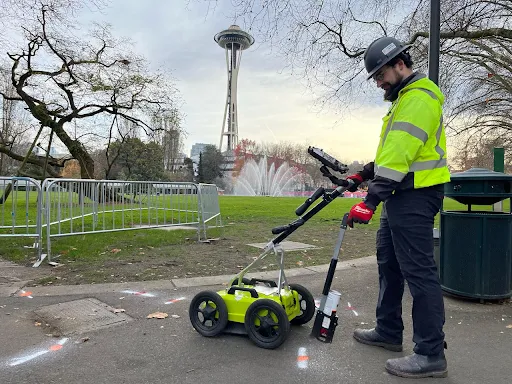
How Concrete Radar Reveals What Lies Beneath — A Deep Dive into Safety & Precision
The strongest structures are only as safe as what lies beneath them. Anyone cutting, coring, or drilling will know the rule not to break: always, always, always look inside concrete first. Concrete radar changes the game — not in all the hype, but in all the accuracy that saves time, money, and sometimes lives. Concrete radar technology is at the forefront of getting the job done the first time, every time, on time.
Why Looking Inside Concrete Matters
Concrete is used everywhere — office towers, highways, bridges, parking garages, and more. Concrete is reliable as a strong product, but full of so many things unseen — rebar, cable, conduits, and possibly voids. Striking any of these without preparation can mean:
- Expensive repairs
- Delays to your project
- Risk to worker safety
- Structural damage
This is why professionals rely on scanning technologies. They bring clarity to the unseen, ensuring work is done right the first time.
How Concrete Radar Works
Think of a concrete radar as a lens that lets you “see” through solid surfaces and visualize them. Using ground-penetrating radar (GPR) emits harmless electromagnetic signals into the slab, which, when returned, creates a map showing what is located inside:
This process is:
- Non-invasive — no drilling required.
- Fast — results are immediate.
- Accurate — it pinpoints depth, location, and layout.
It’s not just about finding obstacles. It’s about planning with confidence.
Beyond the Surface: Practical Applications
Whether it’s construction, renovation, or inspection, knowing what’s in the slab protects both the project and the people. A few areas where radar scanning proves invaluable:
- Drilling and coring: Avoid rebar and conduits before cutting.
- Renovations: Verify safe spots to open walls or floors.
- Engineering assessments: Identify voids or weak points.
- Maintenance: Track down conduits or post-tension cables for upgrades.
One quick scan can prevent weeks of delay.
When Concrete Slab Scanning Becomes Essential
Not every project requires advanced tools. But for large-scale or sensitive work, skipping it is a gamble. That’s where concrete slab scanning makes its mark. Contractors and engineers use it to confirm drawings, double-check utility paths, and avoid last-minute surprises.
It’s like having a roadmap for your structure — clear, reliable, and easy to follow.
Safety: The Hidden Benefit
Budgets and schedules tend to take the focus of the construction world, but safety is the more significant issue. Striking live electrical conduits or disturbing structural reinforcement is not only expensive, it can be deadly; radar scanning gives workers the confidence to keep everyone safe, to eliminate any emergencies, and to not defer work.
Safety also has a secondary value: it builds trust with clients who are confident in working with competent and safe teams, and strengthens a company’s reputation in an industry that expects reliability.
The Role of Skilled Technicians
Technology itself does not resolve problems; rather, it is the people who utilize the technology who help interpret results accurately. A skilled technician can recognize how to read a radar image distinctly and understand rebar from conduits to provide teams with professional directions.
That’s why expertise matters. A scan is only as valuable as the insight it provides.
Precision in Action with CNI Locates
This is why trusted expertise matters; companies like CNI Locates have decades of experience to draw upon for each project. Their skilled technicians have over 15 years of experience with underground utility detection & inspection in Oregon & Washington, and work on projects from public utilities to private sites using radar technology and discernment, always to provide safety and clarity.
Their work gives contractors, engineers, and property owners the confidence to move ahead — without second-guessing what lies below.
Conclusion: Seeing Through with Confidence
Concrete may appear solid, but it contains a complicated world below the surface. With modern technology, experts can avoid costly mistakes, protecting structures as well as people. Among these technologies, concrete X-ray scanning offers the best precision for safe planning and execution.
When precision matters, experience matters too. That’s why teams throughout Oregon and Washington trust CNI Locates for their concrete x-ray needs. They give you confidence that every scan is more than a picture — it’s peace of mind.
Learn more at CNI Locates to take the guesswork out of your next project.