

Cooling Tower Market to Reach USD4.4B by 2033: Key Trends Inside Market
Overview
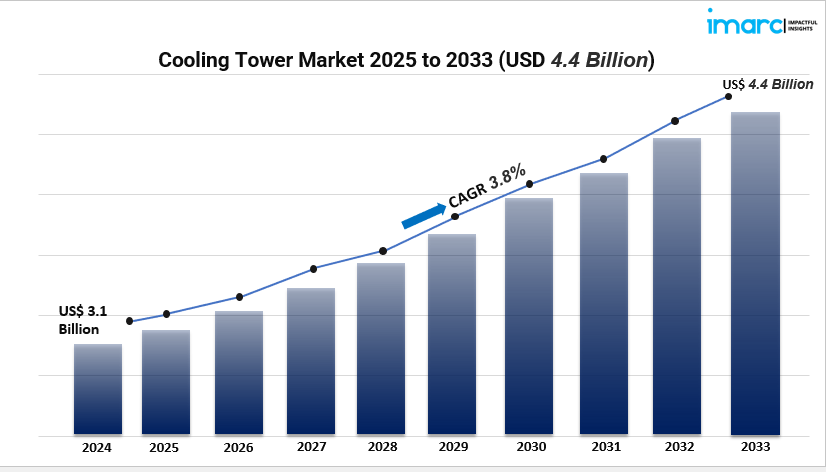
The global cooling tower market is experiencing robust growth, driven by escalating energy costs, a heightened focus on sustainable industrial practices, and the integration of advanced digital technologies. In 2024, the market was valued at USD 3.1 billion and is projected to reach USD 4.4 billion by 2033, expanding at a CAGR of 3.8% during the forecast period. This growth is fueled by the rising demand for energy-efficient cooling solutions across various industries, including power generation, HVAC, and petrochemicals, as well as the adoption of cloud computing and digital monitoring systems that enhance operational efficiency.
Study Assumption Years
- Base Year: 2024
- Historical Years: 2019–2024
- Forecast Years: 2025–2033
Cooling Tower Market Key Takeaways
- Market Size & Growth: The cooling tower market reached USD 3.1 billion in 2024 and is expected to grow to USD 4.4 billion by 2033, registering a CAGR of 3.8% from 2025 to 2033.
- Regional Dominance: Asia Pacific leads the market, driven by rapid industrialization, increasing power generation needs, and supportive government initiatives.
- Tower Type Preference: Open-circuit cooling towers hold the largest market share due to their widespread application in heavy manufacturing and power plants.
- Design Trends: Mechanical draft cooling towers dominate the design segment, favored for their adaptability and consistent performance across various environmental conditions.
- Material Usage: Fiber-Reinforced Plastic (FRP) is the most utilized construction material, appreciated for its durability, corrosion resistance, and lightweight properties.
- End-User Insights: The power generation sector is the primary end-user, relying heavily on cooling towers to dissipate heat during electricity production.
- Technological Integration: The incorporation of digital technologies and cloud computing is enhancing the efficiency and monitoring capabilities of cooling towers.
Market Growth Factors
1. Technological Advancements Enhancing Efficiency
The cooling tower industry is changing fast as digital tech and cloud computing take over. These new tools let companies watch and fine-tune cooling in real time, which boosts productivity and cuts running costs. New ideas like variable frequency drives (VFDs) help adjust fan speeds based on how much cooling is needed saving a lot of energy. Also new hybrid cooling towers that use less water while still cooling well are becoming more popular. Using tough materials like Fiber-Reinforced Plastic (FRP) and High-Density Polyethylene (HDPE) makes cooling towers last longer and resist rust better. These tech upgrades are key to meeting the needs of big industries like power plants, chemical factories, and HVAC systems where good cooling is crucial to run .
2. Industrial Expansion Driving Demand
The growth of industrial activities in developing economies, has a big impact on the cooling tower market. Industries like data centers, manufacturing, petrochemicals, and power production need good cooling systems to keep their products high-quality and their operations running . Fast growth in industry and cities in these areas has made more people want electricity manufactured goods, and infrastructure. This means they need better cooling solutions to handle the heat that comes from making things. Cooling towers are key to keeping industrial facilities running non-stop by controlling temperatures. Also, as data centers get more complex due to digital tech and cloud computing, they need more cooling solutions that can deal with the heat from lots of servers packed together.
3. Regulatory Emphasis on Sustainability
Governments and regulatory bodies around the world are setting tougher rules on emissions, water usage, and energy efficiency. Cooling towers help save water and cut down energy use compared to old-school cooling methods, which makes them a good fit for these new rules. This pushes industries to start using them. Companies that make cooling towers are coming up with new ideas like dry cooling towers to follow water-saving rules. These use less water than the usual systems that work by evaporation. Also new cooling towers now have better filters and air quality controls to meet emission standards. These tough rules are making many industries switch to cooling tech that’s good for the planet and works well.
Request for a sample copy of this report: https://www.imarcgroup.com/cooling-tower-market/requestsample
Market Segmentation
By Tower Type
- Open-Circuit Cooling Towers: These towers allow direct contact between process water and air, facilitating heat dissipation. They are widely used in heavy manufacturing and power plant sectors.
- Closed-Circuit Cooling Towers: In these systems, the process fluid circulates within a closed loop, preventing contamination and reducing water consumption.
- Hybrid Cooling Towers: Combining features of both open and closed systems, hybrid towers offer improved energy efficiency and water conservation.
By Flow Type
- Cross Flow: Air flows horizontally across the falling water, allowing for easier maintenance and lower energy consumption.
- Counter Flow: Air flows vertically upward against the downward flow of water, resulting in higher thermal efficiency and compact design.
By Design
- Mechanical Draft Cooling Tower: Utilizes fans or blowers to move air through the tower, offering precise control over airflow and consistent performance in varying environmental conditions.
- Natural Draft Cooling Tower: Relies on natural convection to circulate air, suitable for large-scale industrial applications with high cooling requirements.
By Construction Material
- Fiber-Reinforced Plastic (FRP): Known for durability, corrosion resistance, and lightweight properties, making it ideal for various industrial applications.
- Steel: Offers high strength and durability, suitable for heavy-duty applications.
- Concrete: Provides robustness and longevity, often used in permanent installations.
- Wood: Traditional material offering cost-effectiveness, though less common in modern installations.
- High-Density Polyethylene (HDPE): Offers excellent chemical resistance and durability, suitable for corrosive environments.
- Others: Includes alternative materials tailored for specific industrial needs.
By End-User
- Chemical: Requires precise temperature control for various chemical processes.
- HVAC: Essential for maintaining optimal temperatures in commercial and residential buildings.
- Petrochemicals and Oil & Gas: Critical for cooling processes in refining and petrochemical operations.
- Power Generation: Integral for dissipating heat generated during electricity production.
- Food and Beverages: Used to maintain specific temperatures during food processing and storage.
- Others: Includes industries like pharmaceuticals, textiles, and pulp & paper requiring cooling solutions.
By Region
- North America (United States, Canada)
- Asia Pacific (China, Japan, India, South Korea, Australia, Indonesia, Others)
- Europe (Germany, France, United Kingdom, Italy, Spain, Russia, Others)
- Latin America (Brazil, Mexico, Others)
- Middle East and Africa
Regional Insights
The Asia Pacific region leads the world’s cooling tower market. This is due to quick industrial growth rising power needs, and helpful government actions. Places like China and India are seeing big money put into building and energy, which drives up the need for good cooling answers. The area’s push for growth that lasts and saves energy also boosts the use of new cooling tech.
Recent Developments & News
The cooling tower industry has made big strides to boost productivity and go green. In February 2023, Baltimore Aircoil Company rolled out its CO₂ (R744) adiabatic condenser/gas cooler. This new product made for transcritical CO₂ systems, focuses on saving energy and water. In November 2023, Metso upgraded its evaporative cooling tower. This new version offers strong dry gas cleaning options for furnace off-gases. Also, in October 2023, SPX Cooling Technologies opened a new factory in Springfield. This move increased its output and created over 60 jobs, showing the industry’s growth and push for new ideas.
Key Players
- Babcock & Wilcox Enterprises Inc.
- Baltimore Aircoil Company Inc. (Amsted Industries Inc.)
- Brentwood Industries Inc.
- Delta Cooling Towers Inc.
- ENEXIO Management GmbH
- Hamon Corporation (Hamon & Cie)
- International Cooling Tower Inc.
- Johnson Controls Inc.
- SPX Cooling Technologies Inc.
- Reymsa Cooling Towers Inc.
- Thermal Care Inc. (IPEG Inc.)
- Thermax Limited (RDA Holdings Private Limited)
Ask Analyst for Customization: https://www.imarcgroup.com/request?type=report&id=2309&flag=C
If you require any specific information that is not covered currently within the scope of the report, we will provide the same as a part of the customization.
About Us:
IMARC Group is a global management consulting firm that helps the world’s most ambitious changemakers to create a lasting impact. The company provides a comprehensive suite of market entry and expansion services. IMARC offerings include a thorough market assessment, feasibility studies, company incorporation assistance, factory setup support, regulatory approvals and licensing navigation, branding, marketing and sales strategies, competitive landscape, and benchmarking analyses, pricing and cost research, and procurement research.
Contact Us:
IMARC Group
134 N 4th St. Brooklyn, NY 11249, USA
Email: sales@imarcgroup.com
Tel No: +1-631-791-1145